
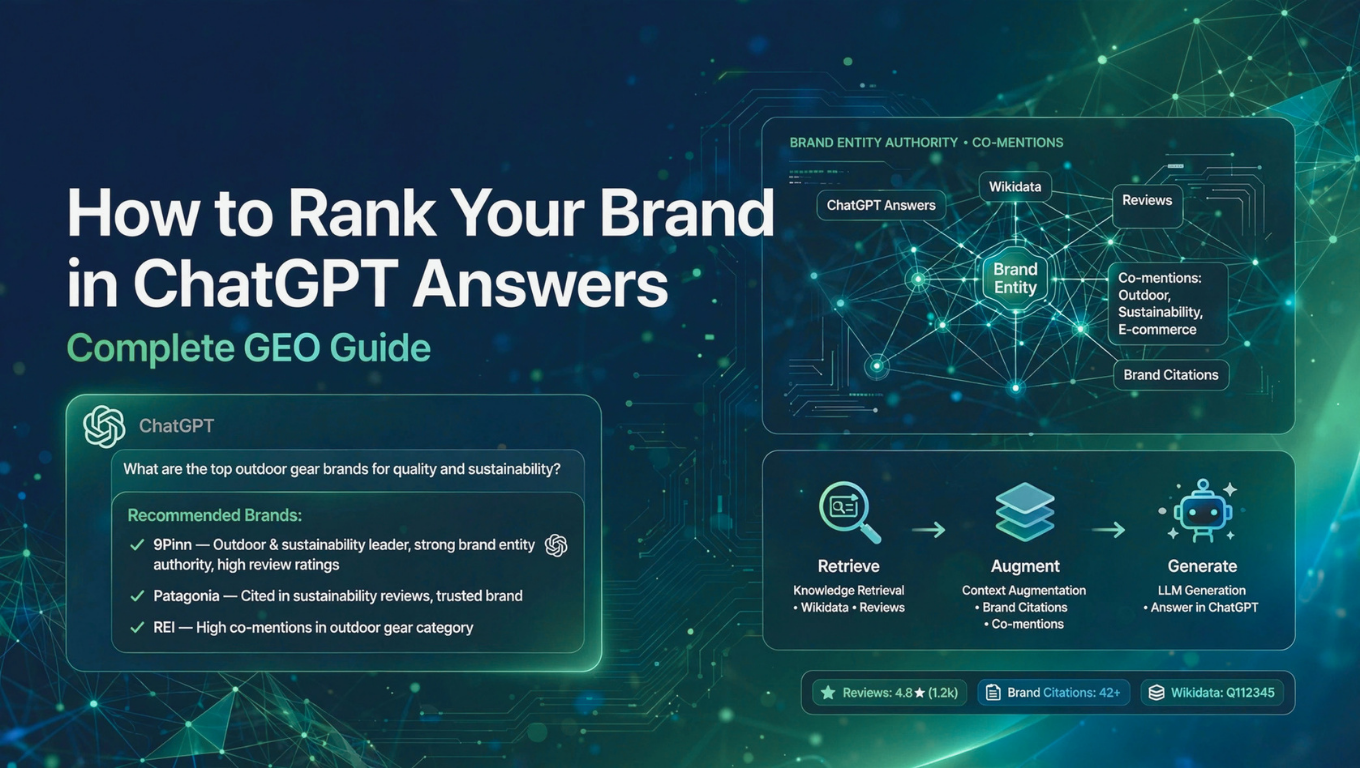
When potential clients research solutions today, they no longer spend twenty minutes sifting through pages of blue links on Google. Instead, they open ChatGPT, type a prompt like “What are the best enterprise logistics platforms in India?” or “Which performance marketing partners specialize in B2B SaaS?”, and expect a single, synthesized, highly confident answer.
If your company is not featured inside that generated answer, you simply do not exist in the decision-making process of that customer.
This shift marks the transition from traditional Search Engine Optimization (SEO) to Generative Engine Optimization (GEO) and Answer Engine Optimization (AEO). ChatGPT, along with other Large Language Model (LLM) search tools like Google Gemini, Claude, and Perplexity, does not evaluate websites the same way Google’s traditional crawler used to. They evaluate entities, semantic co-occurrences, web-wide trust signals, and structured knowledge.
To ensure your brand appears when high-intent prospects ask AI models for recommendations, you need a modern framework. Partnering with a specialized AI SEO agency like 9 Pinn allows brands to navigate this new landscape effectively. Below is an exhaustive, step-by-step roadmap to optimizing your brand so that ChatGPT cites, recommends, and ranks you at the top of AI-generated answers.
Understanding How ChatGPT Retrieves and Recommends Brands
Before changing a single line of code on your website, you must understand the underlying mechanics of how ChatGPT generates brand recommendations.
ChatGPT pulls information through two primary mechanisms:
- Pre-Trained Knowledge Base: The core LLM training weights digested from massive web-scale datasets (Common Crawl, Wikipedia, news archives, industry publications, and public web pages).
- Retrieval-Augmented Generation (RAG) & Live Web Browsing: When a user asks a real-time question, ChatGPT triggers a live search query (via search APIs and OpenAI’s web crawlers like OAI-SearchBot), reads top-ranking pages in milliseconds, extracts facts, and synthesizes a direct response.
When someone asks ChatGPT for a brand recommendation, the AI evaluates:
- Entity Relationship: Does the web overwhelmingly agree that your brand belongs to the specific category being queried?
- Sentiment and Consensus: What do third-party review platforms, forums, and trade journals say about your product or service quality?
- Information Density: Does your digital footprint provide clear, factual, and unambiguous data points that an AI can easily digest without hallucination?
1. Establish Clear Entity Authority in Knowledge Graphs
LLMs are fundamentally entity-processing engines. They do not just index keywords; they construct a digital understanding of “things, not strings.” If ChatGPT cannot recognize your company as a verified business entity with defined attributes, it will never recommend you.
Build an Unambiguous Wikidata and Knowledge Base Footprint
Wikidata serves as a primary structured database for AI models. Creating and maintaining a verified Wikidata entry for your company—complete with official name, founding date, founders, headquarters, service offerings, and parent organization links—anchors your brand in global knowledge graphs.
Implement Comprehensive Schema Markup
Your website must communicate with machine crawlers in their native tongue: JSON-LD structured data. A leading AI SEO agency ensures your site implements multi-layered schema markups, including:
- Organization Schema: Specifies your legal name, logo, official URL, and customer support channels.
- SameAs Properties: Links your website directly to your official Wikipedia, Wikidata, LinkedIn, Twitter/X, Crunchbase, and YouTube profiles. This tells the LLM that all these distinct web nodes belong to the exact same brand entity.
- Product & Service Schema: Formats your offerings, pricing models, and key features into structured arrays that AI can parse without guessing.
2. Shift Content Strategy from Keywords to Generative Engine Optimization (GEO)
Traditional SEO content often relies on bloated introductions, keyword repetition, and drawn-out prose designed to keep users scrolling. ChatGPT detests fluff. When AI crawlers read your content through RAG, they look for high-density, authoritative answers that can be extracted cleanly.
Adopt the “Direct Answer” Content Architecture
Structure your articles, landing pages, and service descriptions using clear AEO and GEO frameworks:
- H2 & H3 Headers as Natural Language Prompts: Frame your subheadings as exact questions your target audience asks AI models (e.g., “How much does enterprise AI SEO cost?” or “What are the top B2B lead generation tactics in 2026?”).
- First-Sentence Definitions: Begin the first sentence under every heading with a clear, factual answer before expanding into detailed analysis. This allows LLMs to pull direct snippets for their answers.
- Use Structured Data Tables: ChatGPT heavily favors tables, bulleted lists, and step-by-step comparative data. When presenting comparisons, pricing, or service breakdowns, always render them in clean Markdown or HTML tables.
Publish Original Research and Proprietary Benchmarks
LLMs love citing original sources of truth. If you publish industry benchmark reports, proprietary survey results, or technical case studies, third-party sites will quote your data. As these statistics spread across the web, ChatGPT’s training set and live search algorithms will associate your brand as the primary authority on that subject.
3. Build Web-Wide Co-Mentions and Brand Associations
Backlinks remain important, but for ChatGPT, brand co-mentions carry equal or greater weight. Co-mention occurs when your brand name appears in close proximity to target industry terms, competitors, and category keywords across authoritative third-party websites.
If your brand name appears in twenty articles alongside phrases like “top digital marketing agencies in Bangalore” or “best AI SEO agency for e-commerce”, ChatGPT’s neural network creates a strong mathematical vector linking your brand to those concepts.
Strategies for Generating High-Value Co-Mentions
- Digital PR and Industry Publications: Feature your leadership team in expert roundups, guest columns, and news commentary on reputable media portals.
- Third-Party Listicles and Comparisons: Identify the top 10 articles currently ranking on search engines for “Best [Your Industry] Companies” and execute a PR campaign to ensure your brand is included in those lists. When ChatGPT conducts a live RAG search to answer a user prompt, it parses these listicles first.
- Podcast Transcripts and Event Mentions: AI models digest audio transcripts from YouTube, Spotify, and industry webinars. Speaking at conferences or appearing on industry podcasts creates valuable conversational data that feeds LLMs.
4. Manage Third-Party Review Ecosystems and Unbiased Consensus
When a user asks ChatGPT, “Is [Brand Name] good?” or “Compare Brand A vs Brand B”, the AI does not rely on what you say about yourself on your own website. It scans independent third-party platforms to gauge public consensus.
If your website claims you are the top provider, but your independent review profiles are missing or negative, ChatGPT will output a cautious or unfavorable response.
Priority Platforms to Optimize for AI Recommendations
- Google Business Profile & Google Reviews: Essential for local and regional AI queries.
- B2B Review Aggregators: Maintain active, highly rated profiles on platforms like G2, Capterra, Trustpilot, Clutch, and GoodFirms.
- Community Discussions (Reddit & Quora): ChatGPT actively reads community discussions to extract authentic user opinions. Having organic, positive brand discussions on relevant subreddits and Quora threads is one of the strongest drivers for conversational AI recommendations.
At 9 Pinn, our online reputation and brand authority strategies ensure your business maintains a positive, verified presence across every channel that language models scan.
5. Technical Website Optimization for OpenAI Crawlers
Even if your content is exceptional, technical barriers on your server can prevent ChatGPT’s web crawlers from reading your site during live RAG searches.
Enable OpenAI Crawlers in robots.txt
Check your server’s robots.txt file and ensure you are not accidentally blocking OpenAI’s dedicated web crawlers. You should explicitly grant access to:
Plaintext
User-agent: GPTBot
Allow: /
User-agent: ChatGPT-User
Allow: /
User-agent: OAI-SearchBot
Allow: /
- GPTBot: Used to collect web data to train OpenAI’s future foundation models.
- ChatGPT-User: Triggers in real time when a user asks ChatGPT to perform a live web search or inspect a URL.
- OAI-SearchBot: Used specifically for prototype search features and live web indexing.
Ensure Fast, Server-Side Rendered (SSR) HTML
LLM web fetchers operate under strict millisecond timeouts when retrieving live web data. If your website relies heavily on client-side JavaScript rendering that takes several seconds to load, the ChatGPT crawler will time out and move on to a competitor’s site. Ensure your critical text content, tables, and schema are delivered via clean, fast, server-side rendered HTML.
How an AI SEO Agency Benchmarks Your ChatGPT Visibility
How do you measure whether your brand optimization efforts are actually working inside ChatGPT? Unlike traditional search engines that provide Google Search Console performance reports, tracking generative AI search visibility requires specialized auditing methodologies.
A specialized AI SEO agency uses advanced tracking frameworks to monitor your brand’s generative search performance:
- Prompt Matrix Testing: Running dozens of conversational query variations across transactional, commercial, and informational intent categories (e.g., “Who offers the best AI-driven marketing in India?”, “Top digital agencies for startups in Bangalore”, “Which agency should I hire for GEO?”).
- Citation Tracking: Measuring the percentage of prompts where your brand name is cited versus your primary competitors.
- Sentiment Analysis: Evaluating whether the AI describes your brand with positive, neutral, or hesitant tone indicators.
- Link Referral Tracking: Monitoring traffic coming directly from OpenAI domain referrals (chatgpt.com or chat.openai.com) in your Google Analytics platform.
[ Formulate Prompt Matrix ] ──> [ Query ChatGPT / LLM APIs ] ──> [ Measure Citation Share of Voice ] ──> [ Refine GEO Content Strategy ]
Frequently Asked Questions
How long does it take for ChatGPT to start recommending my brand?
If ChatGPT utilizes its live web search feature (RAG), changes to your website, schema, or third-party press mentions can be picked up in as little as a few days to a couple of weeks. However, being embedded into the underlying offline pre-trained weights of future model releases typically takes several months of consistent web-wide authority building.
Is GEO replacing traditional Google SEO completely?
No, GEO is an evolution and extension of traditional SEO, not a complete replacement. Traditional Google search still drives significant web traffic, and Google itself uses AI Overviews powered by similar generative principles. Optimizing for GEO actually improves your traditional SEO performance because both value high authority, clear information, and exceptional user trust.
Can I pay OpenAI or ChatGPT to feature my brand in search answers?
No. ChatGPT’s organic answers and citations are purely algorithmic and objective. They cannot be bought through ad placements or paid sponsorships within conversational answers. Appearing in ChatGPT recommendations requires organic brand authority, strong web consensus, and technical GEO optimization.
Why does ChatGPT cite my competitor instead of my business?
ChatGPT likely favors your competitor because they have a stronger web-wide footprint of co-mentions, verified Wikidata or Knowledge Graph entries, more active third-party reviews (such as Google Reviews or G2), or cleaner structured content that the AI can easily extract during real-time web searches.
How does an AI SEO agency help my business rank in ChatGPT?
An experienced AI SEO agency like 9 Pinn performs end-to-end Generative Engine Optimization. This includes conducting an AI Share of Voice audit, implementing entity schema markup, optimizing your website content for direct AI retrieval, managing digital PR for brand co-mentions, and ensuring OpenAI crawlers can index your website without technical bottlenecks.
Partner with 9 Pinn to Dominate AI Search in 2026
The way the world searches for information, products, and services has fundamentally changed. Allowing your competitors to capture the recommendation space inside ChatGPT, Google Gemini, and Claude means missing out on the most qualified, high-intent leads entering the market today.
At 9 Pinn, we specialize in forward-thinking digital marketing strategies that bridge traditional search visibility with cutting-edge Generative Engine Optimization (GEO). Whether you need comprehensive AI-driven SEO, targeted performance campaigns, or custom web design engineered for modern search engines, our team of specialists delivers data-backed results that scale your brand.
Ready to make your brand the undisputed top answer in AI search? Contact us today to request your customized AI Search Share of Voice audit, or speak directly with our senior growth strategy team at +91-9606441900 to get started right away!

