
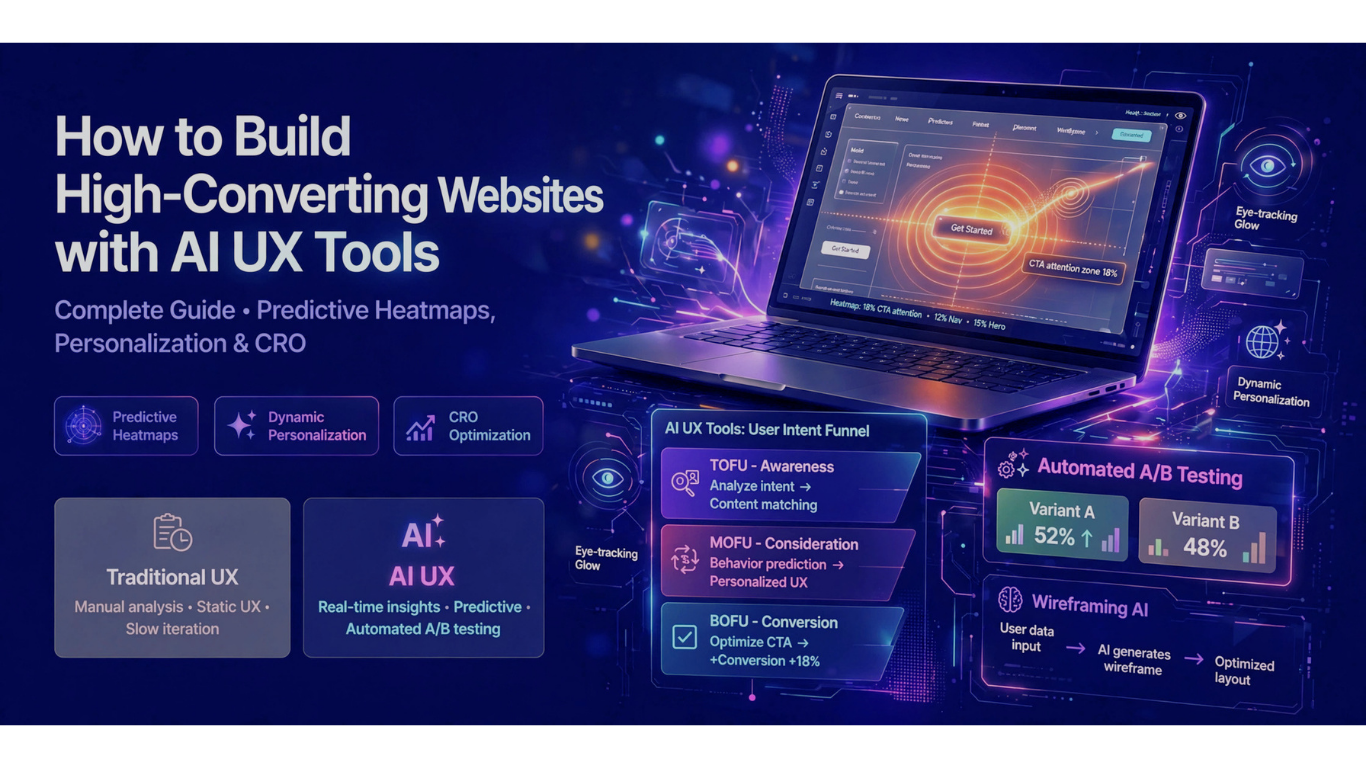
A business website is no longer a static digital brochure. It is a 24/7 sales engine, an interactive brand experience, and the central hub of every digital marketing campaign. Yet, a staggering 97% of website visitors leave without taking a single meaningful action—whether that is filling out a lead form, making a purchase, or booking a consultation.
Why do most corporate websites fail to convert? The answer almost always lies in user experience (UX) friction.
Traditionally, designing a website that converts required months of guesswork, expensive user testing, and reactive A/B experiments after launch. By the time a business realized a page layout was confusing, thousands of qualified visitors—and lakhs of rupees in potential revenue—had already slipped through the cracks.
Enter Artificial Intelligence in UX Design.
Today, modern web design leverages predictive AI models, automated visual attention heatmaps, real-time personalization engines, and intelligent wireframing software to eliminate design guesswork before a single line of code is written. By combining data-driven user psychology with automated design tools, businesses can build digital platforms engineered specifically for maximum conversion.
Whether you are rebuilding an enterprise portal or looking for an expert website design company to scale your digital presence, this comprehensive guide will walk you through how AI UX tools work, the core pillars of AI-driven conversion rate optimization (CRO), and how to deploy them to build high-converting websites.
What Are AI UX Tools and How Do They Drive Conversions?
AI UX tools are software applications that utilize machine learning algorithms, computer vision, and behavioral predictive models to analyze, generate, and optimize user interfaces (UI) and user journeys for maximum clarity and engagement.
Step-by-Step Framework to Build an AI-Engineered, High-Converting Website
If you are planning a website redesign or building a digital platform from scratch, follow this structured, step-by-step roadmap to ensure your site is built for maximum conversions.
Step 1: Map User Intent and Information Architecture
Before designing any visual elements, analyze the search intent and user expectations behind your primary target keywords. Use AI-driven search intelligence tools to map out what information prospects need at every stage of their buyer journey:
- Top-of-Funnel (TOFU): Needs clear problem-solving content, educational resources, and simple navigation.
- Middle-of-Funnel (MOFU): Requires comparative tables, feature breakdowns, case studies, and social proof.
- Bottom-of-Funnel (BOFU): Demands prominent booking forms, transparent pricing, live chat, and strong trust badges.
Organize your sitemap logically so that any user can reach their desired destination within two clicks from the homepage.
Step 2: Run Predictive Heatmap Audits on Design Prototypes
Once your wireframes and visual UI mockups are ready, run them through predictive attention software before handing them over to web developers.
What to look for in your AI heatmap report:
- Is your primary CTA button highlighted in a high-attention visual zone (aim for at least 15–20% focal weight)?
- Are secondary elements (like social media icons or decorative graphics) distracting from the core value proposition?
- Is the main value proposition headline immediately readable without clutter?
Refine visual hierarchy, adjust color contrast ratios, and expand whitespace around key action areas until the predictive AI score confirms optimal visual clarity.
Step 3: Align UX Layout with Conversion-Engineered Copywriting
Great UX design and persuasive copywriting are inseparable. No matter how clean your layout looks, if your headline is vague or uninspiring, users will bounce.
Structure your landing page copy using clear, scannable hierarchies:
- The Hero Section: State clearly what your business does, who you serve, and the primary benefit you deliver within the first viewport.
- Scannable Subheadings: Frame subheadings as clear solutions or direct answers to common customer questions.
- Bullet Points and Micro-Copy: Break up long paragraphs into digestible bullet points. Place reassuring micro-copy right below CTA buttons (e.g., “No credit card required • Free 15-minute consultation • 100% confidential”).
Step 4: Implement Continuous Automated A/B Testing Post-Launch
Launching your website is not the end of the design process; it is the baseline. Once your site is live and receiving traffic, set up automated AI conversion rate optimization tools to run multivariate tests continuously.
Unlike manual A/B testing—which requires waiting months for statistical significance on a single test—AI testing platforms automatically shift traffic allocation toward high-performing design variants in real time, constantly maximizing conversion rates on autopilot.
Traditional Web Design vs. AI-Enhanced UX Web Design
Understanding the operational shift between traditional web design methods and modern AI-enhanced UX architecture highlights why businesses are making the upgrade:
| Feature / Metric | Traditional Web Design | AI-Enhanced UX Web Design |
| Design Decision Basis | Designer intuition, client personal preference, static templates | Predictive eye-tracking, behavioral datasets, machine learning models |
| Pre-Launch Testing | Limited or non-existent due to high cost and time constraints | Instant predictive attention heatmaps and cognitive load scoring |
| Conversion Optimization | Manual post-launch A/B testing taking months per iteration | Continuous, automated AI traffic routing and dynamic variant testing |
| User Personalization | Static, identical content for every visitor | Real-time dynamic messaging based on traffic source, geography, and intent |
| Wireframing & Prototyping | 3 to 6 weeks of manual layout drawing | Generated and refined in days using AI wireframing tools |
| Long-Term Scalability | Requires complete redesigns every 2–3 years | Evolves continuously based on real-time user interaction data |
Why Partnering with an Advanced Website Design Company Matters
While AI UX tools provide incredible predictive power and speed, tools alone do not create extraordinary web experiences. An algorithm can calculate visual contrast, but it cannot understand your brand’s unique story, emulate human empathy, or construct a strategic business positioning model.
To build a truly category-defining digital platform, you need the perfect synergy of advanced AI UX technology and senior human design strategy.
This is where partnering with a professional website design company like 9 Pinn makes all the difference.
At 9 Pinn, we blend modern data science with world-class creative engineering. We don’t just build visually appealing websites; we engineer revenue-generating digital assets tailored to your business goals.
How 9 Pinn Transforms Your Web Presence
- Data-Backed Architecture: We utilize predictive heatmapping and AI user-flow modeling during the initial design phase to eliminate user friction before launch.
- Conversion-Engineered UI/UX: Every font choice, button placement, whitespace ratio, and copy block is strategically crafted to guide visitors toward conversion.
- Full-Stack Engineering & Speed Optimization: We build lightweight, ultra-fast, server-side rendered websites that load in milliseconds, satisfying both real users and Google Core Web Vitals.
- Search Engine & GEO Readiness: Our web architectures are built from the ground up with structured JSON-LD schema, clean heading hierarchies, and Answer Engine Optimization (AEO) frameworks so your site ranks seamlessly across Google, ChatGPT, and Gemini.
Frequently Asked Questions
How do AI UX tools improve website conversion rates?
AI UX tools improve conversion rates by eliminating visual clutter, predicting user attention patterns, and optimizing user paths before a website goes live. By identifying where visitors experience cognitive friction or miss key Call-to-Action buttons, these tools allow designers to create cleaner layouts that guide users effortlessly toward making a purchase or submitting a lead form.
Will AI UX tools replace human web designers and UX developers?
No, AI UX tools will not replace human designers; rather, they empower them. AI handles repetitive tasks like data gathering, visual heatmapping, initial wireframe generation, and multivariate testing. Human strategists and designers remain essential for creative brand storytelling, empathetic user research, strategic business positioning, and custom coding.
How does predictive eye-tracking work before a website goes live?
Predictive eye-tracking software uses deep learning neural networks trained on extensive databases of real human eye-tracking sessions. When a design image or wireframe is uploaded, the AI analyzes visual elements like color contrast, edge density, text hierarchy, and image positioning to generate a map predicting where human eyes will focus during the first few seconds of viewing.
How does AI-driven UX design impact Google Search rankings and Core Web Vitals?
AI UX design directly improves search rankings by creating clean, intuitive user interfaces that reduce bounce rates, increase dwell time, and improve overall user engagement metrics. Furthermore, AI-optimized code structures ensure fast page load speeds, responsive mobile layouts, and excellent Core Web Vitals performance, which are critical ranking factors for Google and generative search engines.
How much does it cost to build an AI-optimized conversion website?
The cost of building an AI-optimized website varies depending on business complexity, total page count, custom functionality, and integration requirements. Investing in a conversion-focused website built by an experienced digital partner typically yields a far higher return on investment (ROI) by significantly reducing customer acquisition costs across all your marketing channels.
Transform Your Website into a High-Converting Sales Engine Today
Your website is the digital front door to your business. Leaving its performance to guesswork, outdated templates, or purely aesthetic design choices means leaving revenue on the table every single day. By leveraging cutting-edge AI UX tools alongside strategic design expertise, you can create a digital platform that captures attention, builds immediate trust, and turns traffic into loyal clients.
At 9 Pinn, we specialize in designing and engineering high-performance, conversion-engineered websites that deliver measurable business growth. Whether you need a complete enterprise website redesign, a high-converting landing page ecosystem, or a custom web application, our expert team is ready to bring your vision to life.
Ready to upgrade your web presence and maximize your online conversions? Contact us online today to schedule a comprehensive digital strategy session, or call our expert team directly at +91-9606441900 to discuss your project requirements!

