
When modern decision-makers, software engineers, corporate executives, and tech-savvy consumers look for information today, they increasingly bypass the traditional search bar. Instead of clicking through pages of search engine ad results and sponsored links, millions of users open Perplexity AI or Claude Search to get instant, synthesized, and direct answers to their queries.
These platforms do not simply present a list of website links. They process natural language prompts, query the live web in real time, extract factual passages from top sources, and synthesize an answer complete with inline citations.
If your company’s content is not structured for Retrieval-Augmented Generation (RAG) and conversational search crawlers, your brand remains completely invisible to this rapidly growing audience.
Transitioning from traditional Search Engine Optimization (SEO) to Generative Engine Optimization (GEO) requires a fundamental shift in how you write, format, and deliver web content. Partnering with a specialized GEO agency like 9 Pinn allows forward-thinking brands to build systematic AI visibility, ensuring your content is cited, recommended, and credited across next-generation search tools.
Below is an exhaustive, technical, and strategic playbook for optimizing your website content specifically for Perplexity and Claude Search.
1. Understanding the Mechanics: How Perplexity and Claude Retrieve Web Information
To optimize for Perplexity AI and Claude Search, you must first understand how their underlying search architectures locate and process web content. Both platforms combine advanced Large Language Models (LLMs) with real-time web retrieval engines, but their retrieval behaviors differ significantly from traditional Googlebot indexing.
The Separation of Training Bots and Live Search Crawlers
Both Anthropic (Claude) and Perplexity deploy separate user-agents for model training versus real-time query retrieval:
- Training Crawlers (ClaudeBot, GPTBot): These crawlers scrape public web data periodically to train foundational AI models offline.
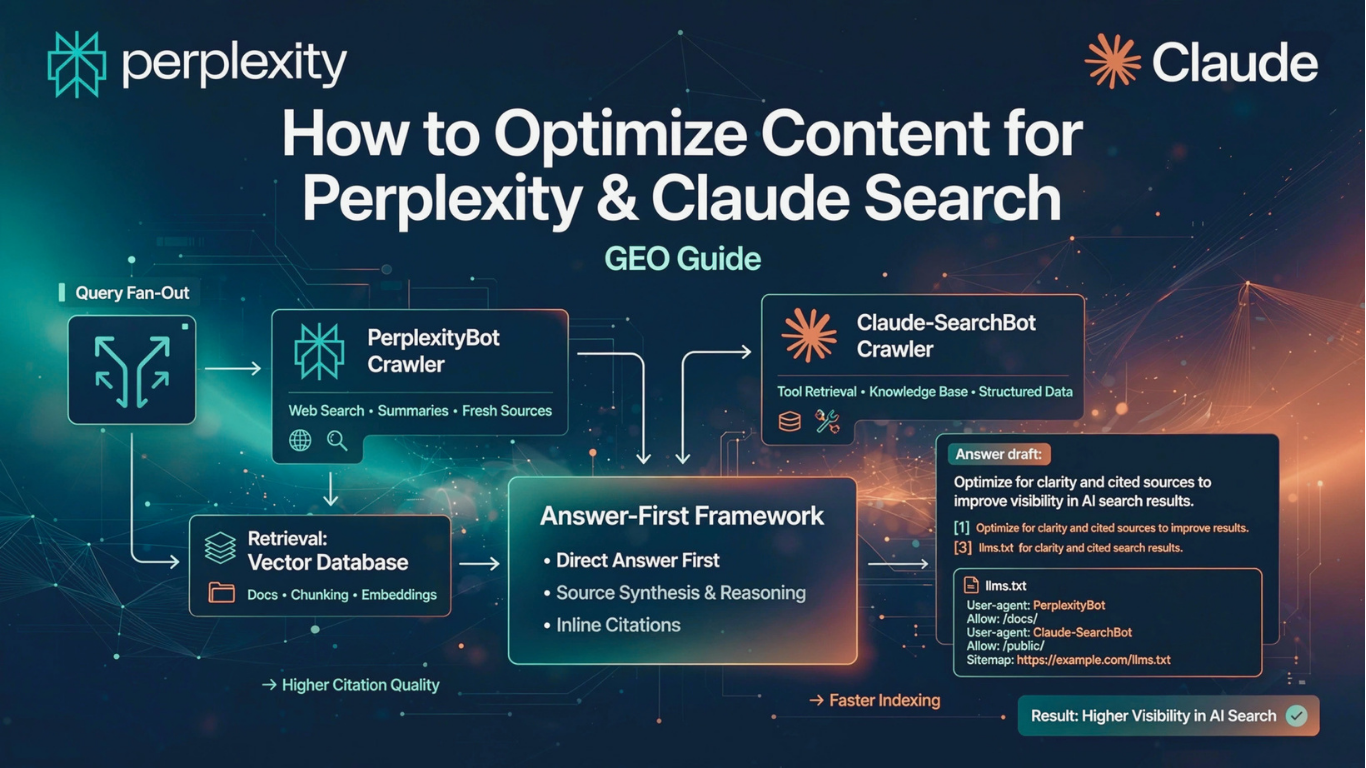
- Real-Time Search Crawlers (Claude-SearchBot, PerplexityBot): These crawlers operate live when a user submits a search query. They fetch pages in milliseconds to retrieve real-time context.
- On-Demand User Request Agents (Claude-User, Perplexity-User): Triggered directly when a user inputs a specific URL into the chat interface for instant analysis.
A technical GEO agency ensures that your server configurations explicitly grant access to real-time search crawlers (Claude-SearchBot, PerplexityBot) in your robots.txt file, even if you choose to restrict offline model training bots.
Query Fan-Out and Latency Tolerance
Neither Perplexity nor Claude searches for the exact raw phrase typed by a user. Instead, they perform query fan-out—rewriting the user prompt into multiple concurrent, semantically related sub-queries to fetch broader background context.
Furthermore, real-time AI crawlers operate under extremely tight latency budgets
- The Single-Hop Rule: If an AI search bot encounters multiple redirect hops (e.g., http:// to https:// to www. to trailing slash), it will frequently abandon the request due to latency, generating an answer without citing your page.
- JavaScript Dependency: Content rendered exclusively through client-side JavaScript often fails to be parsed during fast-paced RAG cycles. Server-Side Rendering (SSR) or pre-rendered static HTML is essential for AI citability.
2. Content Structuring for High Citability: The “Answer-First” Framework
Perplexity and Claude evaluate content based on citability scores—how easily an isolated passage can be extracted to answer a specific user query without requiring broader context.
To maximize your chances of being cited in generated responses, implement the “Answer-First” structural framework across all key landing pages and articles.
Answer First, Explain Second
Eliminate long, fluff-filled introductory paragraphs. When introducing a topic or heading, state the direct core answer or definition in the very first sentence.
Build Self-Contained Passages
AI search engines slice webpage HTML into distinct text blocks (chunks). If a paragraph relies heavily on ambiguous pronouns (like “This process helps them do it faster”), the parser cannot understand the context when reading that standalone chunk. Ensure key paragraphs explicitly name the subject, brand, methodology, and outcome directly within 3 to 4 sentences.
Leverage Structural Elements (Tables, Lists, and H2/H3 Tags)
Perplexity and Claude heavily prioritize structured formatting when synthesizing data:
- Descriptive Headings: Use H2 and H3 tags that match natural language questions (e.g., “How Does Perplexity AI Calculate Citation Ratings?” rather than generic titles like “Methodology”).
- Markdown Tables: Tables are golden for AI extraction. When comparing tools, pricing models, timelines, or specifications, present the data in clean HTML or Markdown tables.
- Numbered and Bulleted Lists: Use bullet points for sequential steps, checklists, and feature breakdowns.
3. Grounding Content in Primary Evidence and Factual Proof
Generative AI models are programmed to minimize hallucinations by preferring content that contains hard evidence, primary citations, and verified data. Claude and Perplexity actively evaluate whether a page distinguishes factual claims from subjective opinion.
Incorporate Empirical Data and Statistics
Include exact percentages, research metrics, financial benchmarks, and dates within your copy. For example, stating “AI search queries increased by 140% year-over-year in 2026” gives the RAG parser a concrete data point to cite, whereas writing “AI search is growing very fast” provides zero citable value.
Attribute Claims to Primary Sources
When citing facts or trends, attribute them directly within the prose (e.g., “According to Anthropic’s developer documentation…” or “Data published by 9 Pinn indicates…”). Content that credits authoritative sources receives higher trust scores during the AI synthesis phase.
Publish Original Case Studies and Proprietary Findings
Publishing original research, client case studies, and proprietary industry reports turns your website into a primary source of truth. When third-party blogs reference your statistics, AI search engines index those cross-references, cementing your brand as a category authority.
4. Technical and Schema Foundations for Perplexity & Claude
Optimizing copy is only half the battle; your website’s technical architecture must allow AI crawlers to discover, digest, and verify your structural data instantly.
Serve an /llms.txt File at Your Root Directory
The /llms.txt file has emerged as a widely adopted web standard for guiding AI search bots. Similar to sitemap.xml, an /llms.txt file provides a clean, Markdown-formatted directory of your site’s most important pages, documentation, and service summaries, allowing AI crawlers to read your core offerings without consuming excessive crawl budget.
Ensure your server delivers /llms.txt and /llms-full.txt directly at root with a clean 200 OK status and zero redirects:
Implement Comprehensive Schema Markup
Rich JSON-LD structured data provides explicit, unambiguous knowledge graph connections for AI parsers. Ensure your site implements:
- Organization Schema: Formats your legal name, logo, official website, and support details.
- Person Schema for Authors: Links author bylines directly to their LinkedIn, Twitter/X, and external credentials using the sameAs array.
- Article & TechArticle Schema: Declares the headline, date published, date modified, author, and publisher entities clearly.
5. Building Off-Page Entity Signals and Third-Party Consensus
Perplexity AI, in particular, relies heavily on external consensus when ranking and recommending companies for commercial or transactional queries. It does not evaluate your website in isolation; it checks what the broader web says about you.
Secure Inclusion in Authoritative Listicles and Directories
When a user asks Perplexity, “What are the top GEO agencies in India?”, the AI crawls leading industry roundups, business review platforms, and trade databases. To appear in those answers, your brand must be actively listed on key third-party platforms:
- B2B Directories: Maintain complete, verified profiles on platforms like Clutch, GoodFirms, G2, Capterra, and Trustpilot.
- Authoritative List Mentions: Execute digital PR campaigns to get featured in industry articles titled “Top 10 Digital Marketing Agencies in Bangalore” or “Best GEO Agencies for Enterprise Growth”.
- Wikidata & Crunchbase: Create and maintain structured profiles on global business databases to reinforce your Knowledge Graph presence.
Drive Semantic Co-Occurrence across Industry Portals
Co-occurrence happens when authoritative websites repeatedly mention your brand name in close proximity to your target service terms. When trade journals, press releases, and marketing blogs mention 9 Pinn alongside terms like “GEO agency”, “Generative Engine Optimization”, and “AI SEO“, AI engines mathematically connect your brand to those service vectors.
Why Partnering with 9 Pinn Accelerates Your AI Search Dominance
Navigating the shifting algorithms of Perplexity, Claude, ChatGPT, and Google AI Overviews requires technical precision, deep data analytics, and advanced content engineering. As a leading GEO agency, 9 Pinn helps businesses transform their digital presence to capture market share across AI-driven search engines.
Our end-to-end Generative Engine Optimization capabilities include:
- AI Share of Voice (SoV) Audits: We evaluate how often your brand is cited across Perplexity, Claude, ChatGPT, and Gemini compared to your top competitors.
- Technical AI Crawler Optimization: We configure your server, robots.txt, /llms.txt, and JSON-LD schema architecture to ensure seamless indexing by real-time AI crawlers.
- Citability Content Engineering: We restructure your landing pages, technical blogs, and service descriptions using high-density, answer-first frameworks designed for instant AI extraction.
- Digital PR & Entity Building: We execute targeted co-mention and listicle acquisition campaigns to cement your brand’s authority across external knowledge graphs and review networks.
Frequently Asked Questions
How does Perplexity decide which websites to cite in its answers?
Perplexity selects citation sources by combining real-time web retrieval (RAG) with authority and readability scoring. It looks for pages reachable with minimal redirect latency, high information density, direct answer formatting, clean schema, and strong third-party brand validation from authoritative directories and review portals.
What is the difference between ClaudeBot and Claude-SearchBot?
ClaudeBot is Anthropic’s background web crawler used to gather public web data for training future foundational Claude AI models offline. Claude-SearchBot is a real-time user-agent deployed specifically to search and fetch live web pages to answer active user prompts inside Claude’s search interface.
Why is my website indexed on Google but absent from Claude and Perplexity?
Googlebot is highly tolerant of complex JavaScript rendering, multiple redirect chains, and deep page structures. Real-time AI crawlers (Claude-SearchBot, PerplexityBot) operate under strict time budgets. If your site relies on client-side JS rendering, has redirect loops, blocks AI user-agents in robots.txt, or lacks direct answer passages, AI engines will skip your page and cite a competitor.
What is an llms txt file and is it mandatory for GEO?
An /llms.txt file is a standardized Markdown document located at your domain’s root directory ([yourdomain.com/llms.txt](https://yourdomain.com/llms.txt)). It provides AI search bots with a clean, concise directory of your core website content. While not legally mandatory, implementing an /llms.txt file significantly improves how efficiently AI crawlers digest and understand your brand’s primary offerings.
How does a GEO agency measure success in generative search?
Unlike traditional SEO, which focuses primarily on Google keyword positions and click-through rates, a GEO agency tracks metrics such as Brand Citation Rate (how often your brand is cited for industry prompts), Share of Voice (SoV) against competitors across AI platforms, sentiment quality in generated answers, and direct referral traffic from AI domains.
Take the Lead in Generative AI Search Today
The shift toward AI-first search is no longer a future prediction—it is the reality of how decision-makers find solutions today. Allowing your brand to remain unoptimized for Perplexity, Claude, ChatGPT, and Google AI Overviews means ceding qualified leads directly to your competitors.
At 9 Pinn, we combine deep technical expertise with advanced Generative Engine Optimization strategies to make your brand the undisputed authority in your industry. Whether you want to perform a comprehensive AI visibility audit, optimize your website technical stack, or launch a full-scale GEO campaign, our team of growth specialists is ready to deliver.
Take control of your brand’s presence in AI search engines. Contact us online to schedule your customized GEO consultation, or call our expert team directly at +91-9606441900 to get started today!

