
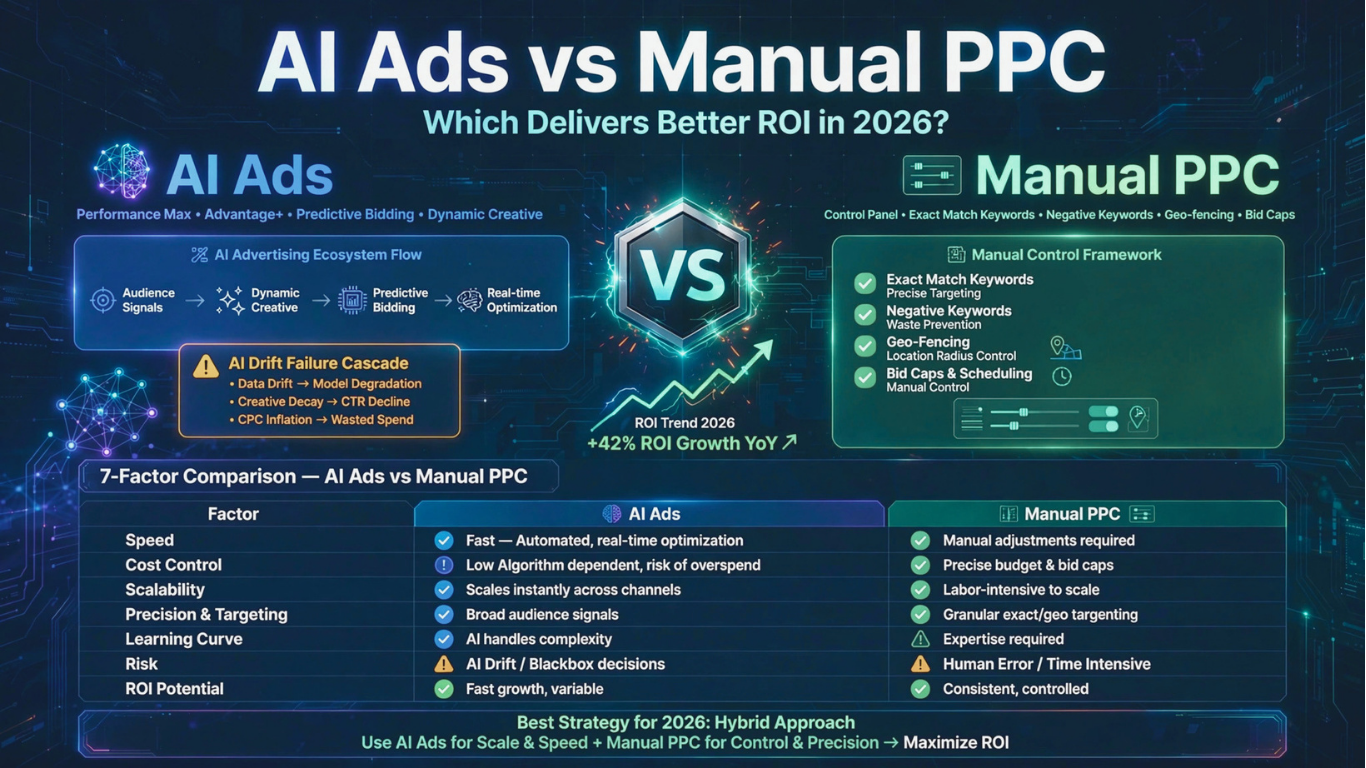
Paid search and performance marketing have undergone a dramatic transformation. Step back just a few years, and a media buyer’s day was dominated by granular keyword match types, manual bid adjustments, single-keyword ad groups (SKAGs), and tedious negative keyword expansion.
Fast forward to 2026: Google Ads operates primarily on automated Performance Max (PMax) architectures, Meta relies heavily on Advantage+ shopping algorithms, and machine learning models process millions of real-time signals per second to adjust bids during ad auctions.
For brand founders, marketing directors, and growth leads across India, this shift raises a critical financial question: Should you hand full control of your advertising budget over to AI algorithms, or does manual PPC management still deliver a superior Return on Investment (ROI)?
If you are evaluating how to allocate your performance marketing budget this year, blindly trusting platform automation can lead to wasted ad spend and low-quality leads. On the other hand, sticking purely to manual tactics means missing out on incredible algorithmic efficiencies.
Below, we dissect the performance data, real-world trade-offs, and strategic nuances of AI Ads versus Manual PPC in 2026—and reveal how a top-tier PPC agency in Bangalore like 9 Pinn leverages a hybrid framework to maximize your returns.
What Are AI Ads in 2026?
When we talk about “AI Ads” in 2026, we are not just talking about generating ad copy using ChatGPT. We are referring to end-to-end algorithmic campaign frameworks where artificial intelligence handles auction bidding, audience discovery, asset placement, and cross-channel budget allocation.
What Is Manual PPC in 2026?
Manual PPC does not mean managing campaigns using stone-age techniques. In 2026, Manual PPC represents strategic human control. It involves setting explicit rules, utilizing exact match keywords, maintaining negative keyword lists, setting manual bid caps, and establishing strict audience parameters.
AI Ads vs Manual PPC: The 7-Factor ROI Comparison
To determine which approach yields better ROI for your business, we must look beyond basic metrics like Click-Through Rate (CTR) and analyze the true levers of profitability.
| ROI Evaluation Lever | AI-Powered Ads (PMax / Advantage+) | Manual PPC Management | Winning Approach in 2026 |
| Bidding Efficiency | Bids in real time on 100+ micro-signals during the auction. | Static bids adjusted periodically by human managers. | AI Ads |
| Search Intent Control | Expands reach automatically; prone to bidding on broad, irrelevant queries. | Strict control using exact match and negative keyword lists. | Manual PPC |
| Lead Quality (MQL to SQL) | High volume, but frequently generates low-intent form fills if unguided. | Lower volume, but significantly higher lead qualification rates. | Manual PPC |
| Creative Assembly & Scale | Dynamically generates hundreds of headline/image combinations. | Requires human designers and copywriters for every variation. | AI Ads |
| Protection Against Ad Waste | Can burn budget rapidly if conversion tracking is flawed. | Protects budget through strict bid caps and keyword exclusions. | Manual PPC |
| Cross-Channel Integration | Seamlessly connects Search, YouTube, Display, and Social. | Requires separate, manually managed campaigns for each platform. | AI Ads |
| Data Requirement | Requires 30–50+ clean conversions per month to train models. | Functions effectively even on low-volume or brand-new accounts. | Manual PPC |
Deep Dive: Where AI Ads Excel (And Where They Fail)
When AI Ads Win Big
AI-driven advertising performs exceptionally well in scenarios where conversion data is abundant, conversion loops are short, and e-commerce tracking is seamless.
- E-Commerce & D2C Brands: If you run an online retail store with hundreds of transactions per week, AI algorithms excel. Tools like Google Performance Max and Meta Advantage+ analyze historical purchase data, identify lookalike buyers, and dynamically display the exact product a user is likely to purchase.
- High-Volume B2C Lead Generation: For high-volume consumer services (such as food delivery apps, real estate inquiries, or online courses), AI bidding helps scale conversion volume while stabilizing Cost Per Acquisition (CPA).
- Cross-Channel Retargeting: Machine learning models track user journeys across devices, delivering retargeting ads at the precise moment a user exhibits high buying intent.
When AI Ads Fail
For many businesses—particularly B2B enterprises, high-ticket service providers, and niche B2B tech firms—relying entirely on AI advertising can damage campaign performance.
The Real-World Scenario:
Imagine a B2B SaaS company offering enterprise HR software. They set up an AI-driven Google Ads campaign optimized for “Form Fills.”
The algorithm quickly learns that it can acquire form fills for ₹150 each on low-quality display networks or by bidding on search terms like “free HR software download” or “HR internship resume sample.” The dashboard shows hundreds of conversions at a low Cost Per Lead (CPL).
However, when the sales team calls these leads, 95% turn out to be students, job seekers, or small business owners looking for free tools. The business spent lakhs of Rupees generating Marketing Qualified Leads (MQLs) that converted into zero Sales Qualified Leads (SQLs) or closed revenue.
This is why hiring an experienced PPC agency in Bangalore is critical: professional media buyers build human guardrails that prevent algorithms from optimizing toward low-quality leads.
Deep Dive: Why Manual PPC Controls Still Save Your Budget
While AI algorithms handle raw computing power, human strategy remains essential for maintaining profitability.
1. Filtering Low-Intent Search Queries
Google’s “Broad Match” algorithms are designed to expand your reach. If you bid on the keyword “PPC agency Bangalore”, an unguided AI campaign might show your ad to users searching for “free PPC course in Bangalore”, “PPC agency jobs for freshers”, or “how to do PPC manually”.
Manual control involves building robust, multi-tiered negative keyword lists that exclude job seekers, students, and DIY researchers, ensuring your budget is spent exclusively on decision-makers looking to hire a professional partner.
2. Guarding Against Fraudulent Clicks
Digital advertising faces ongoing challenges with click fraud, bot farms, and scrapers. Unchecked AI campaigns can spend substantial budget on invalid traffic if display network expansions are left unmonitored. Manual PPC management involves setting strict placement exclusions, blocking suspicious IP blocks, and opting out of low-quality display partner networks.
3. Protecting Brand Positioning
Machine learning tools generate ad variations automatically, but they lack deep brand context. An AI might generate headlines that sound overly promotional, discount-focused, or inconsistent with your brand guidelines. Human copywriters ensure that every headline and description aligns with your company’s strategic positioning.
The Hybrid Sweet Spot: How 9 Pinn Maximizes Your PPC ROI in 2026
The debate between AI Ads and Manual PPC is not an “either/or” choice. In 2026, the highest ROI is achieved through a Hybrid PPC Model—combining the raw computational power of AI bidding with expert human strategic oversight.
At 9 Pinn, a leading digital marketing and PPC agency in Bangalore, we implement a structured Hybrid Performance Framework designed to eliminate ad waste while maximizing pipeline revenue.
How the 9 Pinn Hybrid Framework Works:
- Offline Conversion Tracking (OCT) Integration: We connect your CRM (HubSpot, Salesforce, Zoho) directly to Google Ads and Meta Ads. Instead of telling the AI to optimize for simple “Form Fills,” we train the algorithm to optimize specifically for Sales Qualified Leads (SQLs) and Closed-Won Revenue.
- Human Negative Keyword & Placement Guardrails: We deploy proprietary negative keyword lists and domain placement blocklists, preventing the AI from wasting budget on irrelevant traffic.
- High-Converting Ad Copy & Landing Pages: Our in-house copywriters and web developers craft compelling ad messaging and fast, conversion-optimized landing pages.
- AI-Driven Smart Bidding Execution: With clean conversion signals and strict strategic guardrails in place, we unleash Google and Meta’s Smart Bidding algorithms to bid aggressively on high-converting prospects.
- Continuous Data Auditing: Our media buyers conduct weekly performance audits, analyzing search term reports, placement data, and conversion quality to refine targeting parameters.
Frequently Asked Questions
Which approach is better for small businesses with limited budgets?
For small businesses with monthly ad budgets under ₹50,000, Manual PPC combined with targeted Smart Bidding on Search is typically best. Pure AI campaigns like Performance Max require high conversion volumes (usually 30–50 conversions per month) to train their algorithms effectively. On smaller budgets, AI campaigns can spend money testing irrelevant placements before finding the right audience.
Why are my AI-driven Google Ads generating spam leads?
Spam leads occur when AI algorithms optimize toward soft conversions (like button clicks or simple form submits) without offline validation. Automated bots or low-intent users fill out your forms, and the AI interprets this as a positive conversion signal, leading it to seek out more similar users. Integrating Offline Conversion Tracking (OCT) and adding reCAPTCHA or human verification on landing pages resolves this issue.
Is Performance Max (PMax) better than Search Campaigns for B2B lead generation?
For B2B lead generation, standard Search Campaigns with exact match keywords and tight negative lists usually deliver higher-quality leads than unguided Performance Max campaigns. However, a properly configured PMax campaign using strong audience signals and placement exclusions can complement Search campaigns effectively.
How do I know if my current PPC agency is managing my account properly?
Ask your agency for a transparent breakdown of your search term reports, display placement reports, and conversion tracking setup. If your agency cannot show you active negative keyword management, CRM conversion integration, or clear lead-to-revenue tracking, your budget may be running on unmonitored automation.
How does hiring a specialized PPC agency in Bangalore improve my ROI?
A dedicated PPC agency in Bangalore like 9 Pinn brings cross-industry expertise, advanced conversion tracking tools, and experienced media buyers to your account. We handle campaign strategy, landing page CRO, ad copywriting, tracking integration, and ongoing optimization, ensuring every Rupee spent contributes directly to your bottom line.
Stop Wasting Ad Spend: Partner with 9 Pinn Today
In 2026, relying purely on manual PPC tactics leaves money on the table, while handing full control over to platform AI algorithms can burn through your budget without driving real revenue. Success requires combining smart AI automation with hands-on human strategy.
At 9 Pinn, we help businesses across India and global markets scale their paid acquisition channels predictably. As a full-service performance marketing and PPC agency in Bangalore, we build data-driven Google Ads, Meta Ads, and multi-channel funnels engineered to maximize your real-world pipeline revenue.
Ready to audit your ad accounts and eliminate wasted ad spend? Contact us today to request a comprehensive PPC performance audit, or call our growth team directly at +91-9606441900 to discuss your acquisition goals!

